
How to Make an Airsoft Ghillie Suit: A Step by Step Guide
Nothing in airsoft is quite as satisfying as a sniper or stalker who simply disappears into the undergrowth. A well made ghillie suit is the reason they can. Shop-bought suits are a great starting point, but building or customising your own lets you match the exact colours of the sites you play. This guide walks you through the whole process, from choosing a base layer to the finishing touches on game day.
What a ghillie suit actually does
A ghillie suit is not about colour so much as shape and texture. The human eye picks out the outline of a person, especially the head, shoulders and the straight line of a rifle. Loose, three-dimensional jute breaks up that outline and mimics the random texture of grass, leaves and bracken. Colour matters, but a suit with the right texture in roughly the right colours will beat a perfectly coloured flat garment every time.
The name comes from Scottish gamekeepers, or ghillies, who developed the idea for stalking deer. It was later adopted by the Lovat Scouts in the Boer War, and the British Army has used ghillie-style camouflage for snipers ever since.
Buy or build? If you want to be in the game quickly, a ready-made suit from our ghillie suits and concealment range is the easiest option, and many players then customise it using the techniques below. Building from scratch takes 20 to 40 hours but gives you complete control.
What you need

- A base garment: a durable military-style smock and trousers, a pair of overalls, or a lightweight “viper hood” if you only want to cover your upper body.
- Netting: square mesh netting with holes of roughly 2cm to 4cm. Old camouflage netting or fishing net works well.
- Jute or burlap: around 1.5kg to 2.5kg for a full suit, in four or five colours. Synthetic ghillie thread is lighter and does not rot, but it costs more.
- Strong thread: dental floss or upholstery thread, plus a sturdy needle.
- Fabric glue or a silicone sealant to reinforce stitching on the shoulders.
- Dye (optional): if you buy natural jute you can dye it yourself.
- Fire retardant spray: strongly recommended. More on that below.
Step 1: choose and prepare your base layer
Start with a garment in a muted pattern that already suits your area. Woodland patterns such as Flecktarn, MTP or M81 woodland sets work well in the UK. Choose a size up from normal so you can wear layers underneath in winter.
Before adding anything, reinforce the elbows, knees and chest with an extra layer of canvas or old trouser fabric. You will spend a lot of time crawling, and the front of a ghillie suit takes a beating.
Keep the front clean
The most common beginner mistake is covering the whole suit. The front of your chest, stomach and the inside of your arms should stay bare, because that is the part touching the ground when you crawl. Jute there snags, collects mud and makes movement noisy. Concentrate everything on the back, shoulders, the backs of the arms and legs, and the hood.
Step 2: attach the netting
Cut netting to cover the back of the jacket, the shoulders, the backs of the sleeves and trousers, and the hood. Lay it flat and stitch it down every 5cm to 10cm around the edges, then in a grid across the middle so it cannot sag or snag. Dental floss is perfect here: it is strong, rot-resistant and cheap.
Add a dab of fabric glue over every few stitches on the shoulders and hood, where the suit takes the most strain.
Step 3: choose your jute colours
Look at the sites you play. UK woodland usually needs a mix of olive greens, browns and tans, with seasonal shifts: lusher greens in late spring and summer, more tan and russet in autumn and winter. A good starting ratio for a year-round British woodland suit is:
| Colour | Share of jute | Why |
|---|---|---|
| Olive drab | 30% | The base tone of most UK foliage |
| Light tan / sand | 25% | Dead grass, dry bracken, highlights |
| Dark brown | 20% | Shadow, earth and leaf litter |
| Dark green | 15% | Ivy, holly and deep vegetation |
| Russet / rust | 10% | Autumn bracken and dead leaves |
Before tying, separate the jute into individual strands by unravelling it. Then mix the colours loosely together in a bag so each bundle you pick up is naturally varied. Nature has no neat stripes.
Step 4: tie on the jute
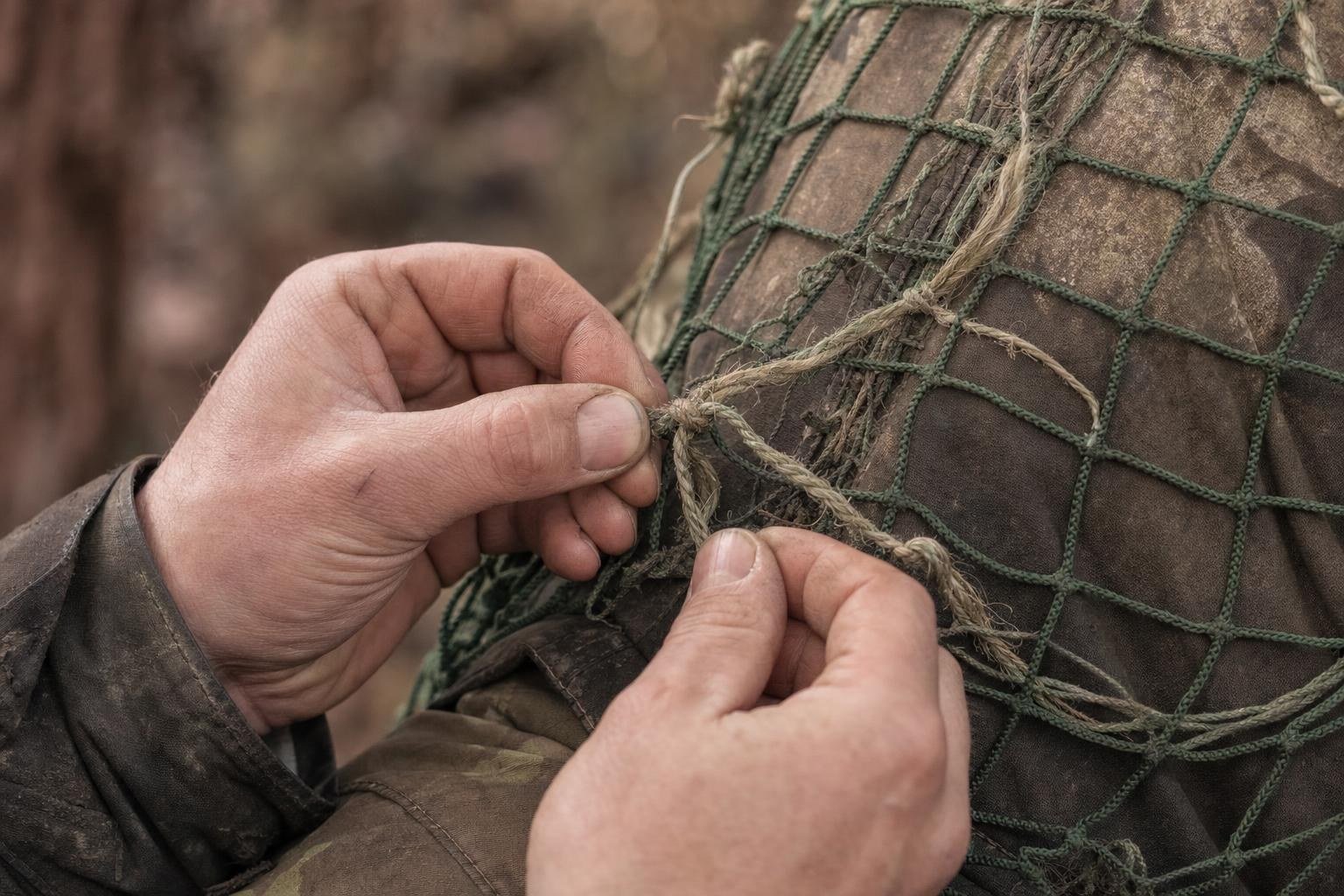
Take a small bundle of mixed jute strands about 30cm to 40cm long, fold it in half, push the loop through a square of the netting and pull the loose ends back through the loop. That is a simple lark’s head knot and it is all you need. Pull it tight.
- Work from the bottom up, like roof tiles, so the strands hang down and overlap naturally.
- Vary the density. Pack the shoulders, hood and upper back thickly, and keep the lower legs lighter to save weight.
- Vary the length. Trim some strands short, leave some long. Uniform length looks artificial.
- Leave gaps in the netting on the shoulders and back so you can tuck in real vegetation later.
- Check from a distance every few hours. Hang the suit outside and look at it from 20 metres away to spot obvious patches or outlines.
When you finish, give the whole suit a vigorous shake and a light trim to remove loose strands. Many builders then roll it in mud or leave it outside for a week to dull down any brightness in the dye.
Step 5: the hood and face
The head is the shape the eye looks for first, so give the hood the most attention. Build it up so it extends over the shoulders and blurs the line between your head and body. Leave a clear window for your eyes and make sure nothing blocks your eye protection or forces it out of position. Pair it with a mesh or fabric face cover in a matching colour from our scarves and balaclavas range.
Safety first: your ghillie must never interfere with your eye protection. Test it fully before you play: lie prone, look around, and make sure your goggles stay sealed and fog-free.
Step 6: wrap your rifle
A perfectly hidden player with a long black rifle is still very easy to spot. Wrap the stock and handguard in strips of hessian, camo tape or a rifle wrap, and tie on a few jute strands to match your suit. Keep the muzzle, hop-up adjustment, magazine well, sights and trigger completely clear. If you want a more permanent finish, see our guide on how to spray paint your airsoft gun.
Step 7: add natural vegetation on the day

The final, and most effective, layer is local vegetation. When you arrive at a site, tuck grass, bracken and small leafy twigs from that area into the gaps you left in the netting. Replace them when they wilt, as dead vegetation changes colour within hours and starts to look wrong.
Always follow site rules: do not cut living trees, and remove your vegetation before leaving.
Fire safety: please read this
Dry jute is extremely flammable. Treat your suit with a fabric fire retardant spray after building it and reapply it after washing. Never smoke while wearing a ghillie, stay well away from campfires and barbecues, and take care with pyrotechnics. Many sites will not allow players in ghillie suits near the safe zone smoking area for this reason.
Maintenance and storage
- Hang the suit to dry completely after every game. Damp jute rots and smells.
- Brush off mud once dry rather than machine washing, which tangles the strands.
- Store it hanging in a breathable bag, away from direct sunlight, which fades the dye.
- Retie loose bundles and top up the jute each season.
Fieldcraft matters more than the suit
A ghillie suit is only half the job. Move slowly, use shadow, stay off the skyline, avoid shine and keep your silhouette low. The best stalkers are the ones who are patient. Get those skills right and your homemade suit will make you almost impossible to find.
Prefer a head start?
Browse ready-made ghillie suits, concealment and camouflage sets, then customise them using this guide.
Shop ghillie suitsShop camo setsFrequently asked questions
How long does it take to make a ghillie suit?
Typically 20 to 40 hours for a full suit, depending on how dense you make it. A hood and shoulder cape can be done in a weekend.
How much jute do I need for a ghillie suit?
Around 1.5kg to 2.5kg for a full jacket and trousers. A viper hood or half suit needs roughly half that.
Are ghillie suits hot to wear?
They can be in summer. Keep the front bare, use a lighter base garment, and consider a hood and shoulder cape instead of a full suit when it is warm. Always stay hydrated.
Can I wash a ghillie suit?
Hand rinse it with cold water if you must, then hang it to dry fully. Machine washing tangles the jute and strips fire retardant, which then needs reapplying.
Is a ghillie suit allowed at all airsoft sites?
Most sites welcome them, but some have rules about where you can wear them and about fire safety. Check with the site before your game.